
Where to Begin?
Brainstorms, timeline sketches and exploratory writing.

Kia ora and welcome to Understory!
What is Understory?
Understory is a container for exploratory writing and prompts to encourage play and experimentation at any stage of a writing practice. I’ll share a short piece of writing, followed by a related prompt and invitation to write. We’ll practice writing in conversation with memory and place, with less control and more imagination.
Where to Begin?
Last week my friend K decided she wanted to write about a time in her life but wasn’t sure where to start or what to capture from within that period. She asked: How do you figure out what blocks of time to write about?
Because memory is associative rather than narrative, I like to start with a brainstorm, list, jumble or cloud of significant moments or events. I write down key details — the more visceral the better — and draw lines between connected ideas. One memory will lead to others, not necessarily in chronological order. Memories speak to each other across time, asking and answering questions.
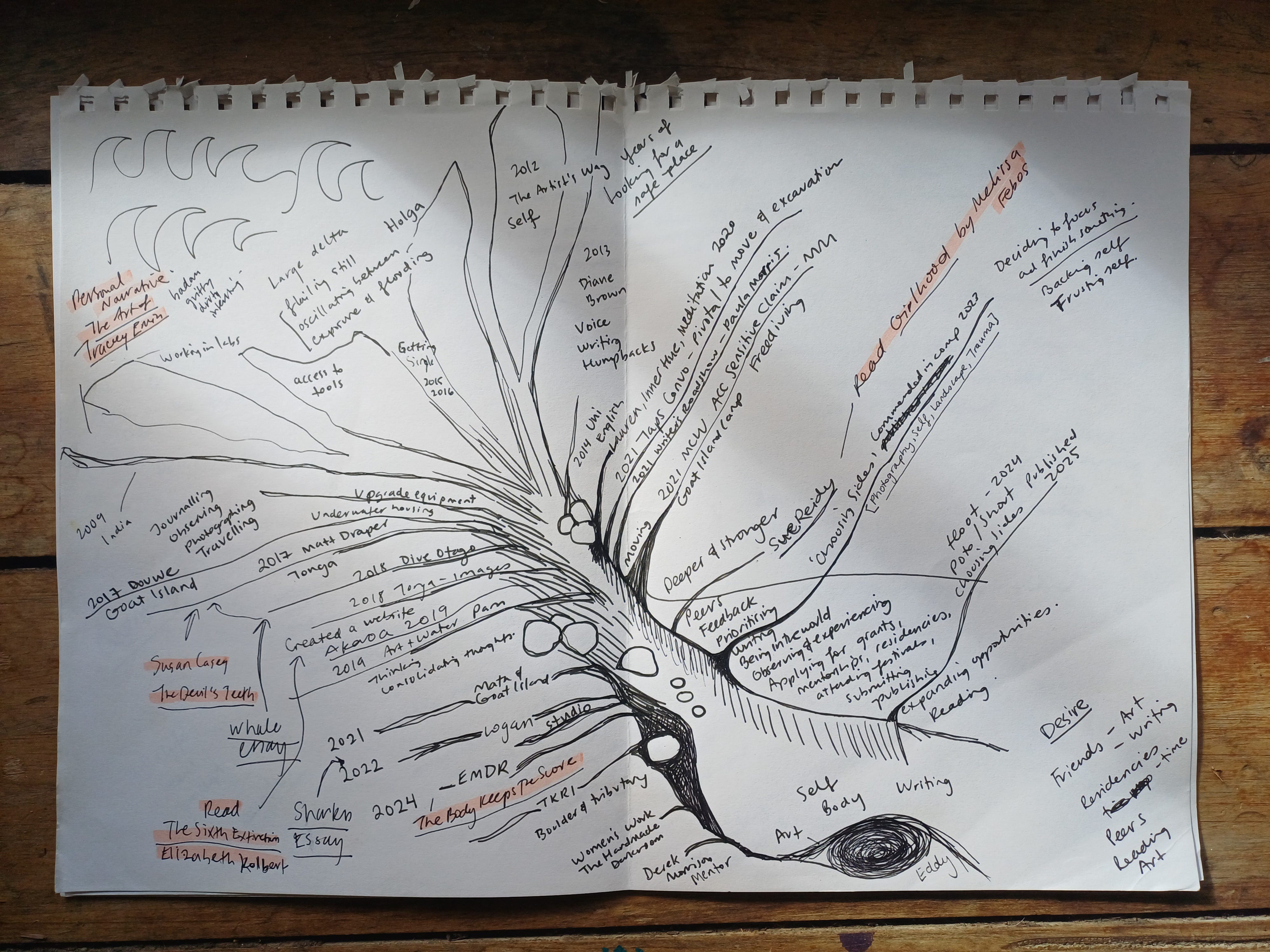
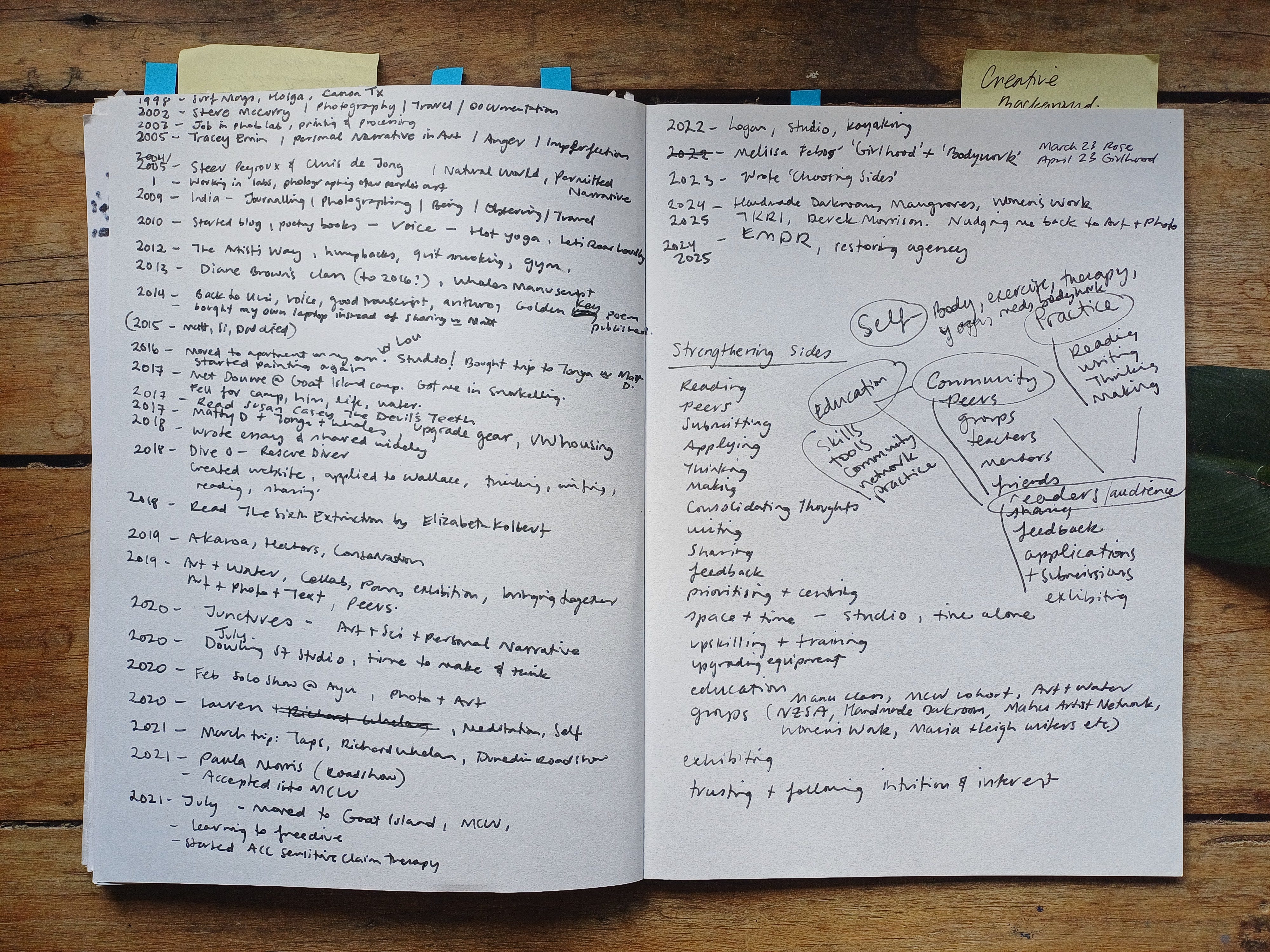
I also like to sketch out a timeline, ideally on a big piece of paper. This can be linear (vertical or horizontal) or follow a metaphor: you can draw a river-line with rapids, boulders, eddies and currents[1]. I typically do this exercise a couple of times as the sketch can become crowded and messy. Embrace the chaos knowing you can create a neater version once you’ve captured what you need.
If you’re already at work on a writing project, make a list of moments or scenes you’ve been putting off or saving, or sketch out a fresh timeline.
You can brainstorm moments and sketch out timelines for a fictional story or a non-fiction narrative of any kind.
If you’re writing about an art project or artwork, sketch out the timeline of your project or write a list of key themes, places, techniques, imagery, and details.
I like to use large, blank sheets or pads of paper or blank workbooks for brainstorms and timelines, but they can be done in a notebook of any size also. If you’re able, take whatever substrate you’ve chosen to the beach, river or somewhere out of doors, anywhere with an expansive outlook to gaze at while you think. Let your attention and focus go soft.
I’m deep in the murky middle of a book-length memoir / essay project. I’ve gathered the brainstorms and timelines for this project from the various workbooks I’ve made them in, and the folded-up sheets of A3 paper tucked inside them — a beautiful mess.
I’ve included examples from a different project using the river analogy and a linear timeline.
Exploratory Writing
When you’re ready for some exploratory writing, grab a fresh notebook if you have one or your project book. Spend five, ten, thirty minutes, or an hour — whatever the demands of your life currently allow. Set a timer. Write by hand or in a note-taking app if you are caught off-guard. I use Day One. It’s free and notes are ordered by date.
Start at the beginning. Start at the end. Start in the middle at a moment of crisis. Start with a memory of a disappointment or a crushing realisation. Imagine the moment from another person’s point of view. Start when you didn’t know anything yet and everything felt possible. Start with a dream. Start with today and write where the past presses in. Start at the shoreline, describing the light. Start with the first time you saw someone or the last time.
Start where you feel a sense of urgency or excitement to proceed. Start where you don’t think you need to or don’t want to. Start with any prompt and see what rushes forward to be written.
My version of this prompt was ten minutes of timed writing by hand then typed. Its raw, messy, fluid, and unpolished.
He had given me a drawing. Handed it to me on the school bus just before we got off. The head of a tiger with its mouth open. I’ve written about the drawing, but I haven’t written about when I went looking for it a couple of years ago. I kept it in a wooden chest at my mom’s down south, full of my sentimental things from childhood and my travels, boxes of letters. I look through the chest every few years. I’ve seen the drawing on previous searches, but last time it was gone, along with letters from a friend who died. I had gone on another shame purge, purging so deeply that even the memory of doing so is blacked out.
The drawing was gone and with it the only evidence I had of the boy, or of his once having given me a drawing. Shame vanishes things, destroys evidence. What a waste after all those years of hanging onto it — twenty-five? And Kahu’s letter’s — how I wish I still had those. No doubt I’d been following some feng shui directive or Marie Kondo’s imperative to get rid of anything that doesn’t bring you joy (to be fair, I haven’t read Marie Kondo’s book, only absorbed that guidance through the wider culture). Joy isn’t the only reason to keep something. Proof for one. Proof that he existed, proof that I did. Proof that I hadn’t imagined the whole thing.
Panic rose in me as I rummaged through the layers of letters in an old shoe box, going deeper and deeper through time, the stack so much thinner than I remembered. Even Kahu’s funeral handout was gone — the one my parents saved for me because I was still in India when he died. How could I? Something in me was trying to survive, move on, put the past behind her, didn’t think she needed it anymore, didn’t think it mattered. She was only doing her best, doing her worst, destroying evidence. The only traces left now are in her.
I switched from first person to third again, that old part of me keen to put as much distance between the event and herself as possible. I don’t blame her.
Ten minutes, even five, is all it takes to get started, to build consistency, to play and experiment. Less control, more imagination! See you next week.
AMB
[1] My friend Kate van der Drift’s short video of using the river analogy is aimed at artists but can be applied to any subject and is a worthwhile exercise.
This is such an interesting process and insight into the way you work. I'm soooo going to try some of these ideas, because THAT is the essential question: When you know everything about your life, how do you choose the parts you must write ...and then make it cohesive, character-driven, and (maybe most of all) understandable for a reader?
Your writing is beautiful - I hope you keep following the thread down. This line especially stood out for me: "Joy isn’t the only reason to keep something. Proof for one. Proof that he existed, proof that I did. Proof that I hadn’t imagined the whole thing." Yes, yes, yes, yes, yes ❤️
I love the river Analogy so much. I’ve taken so much from it so far and it has lead me down a path of research, it has also given me a starting point, a container and some clarity, so much clarity actually.
🙏❤️